
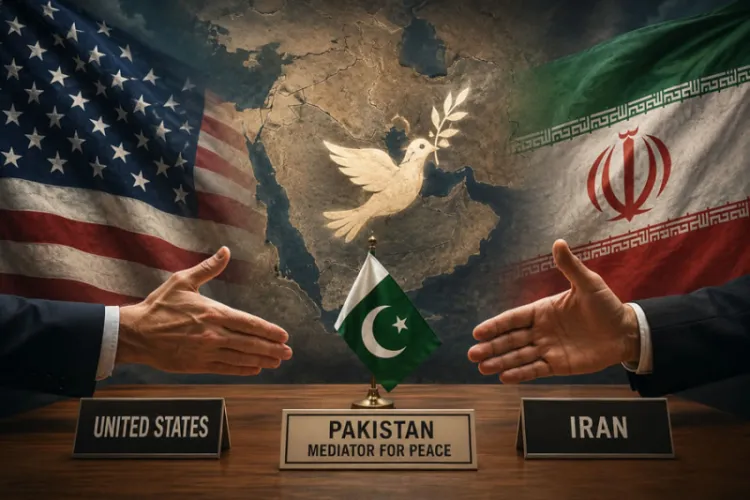
In an era marked between deepening geopolitical rivalries and fragile orders mediation has become essential instrument of diplomacy once again. When a rival refuse to stop, the act of bringing them to the table is itself a form of power.
Pakistan’s recent attempt to mediate between Iran and the US reflects both strategic necessity and the diplomatic ambition. Yet the central question remains same, is Pakistan merely caught in the middle of a complex conflict or it becomes successful in shaping the outcomes.
The US Iran rivalry is deeply rooted and can’t be resolved only through facilitation and goodwill alone. This rivalry is not a typical diplomatic dispute but it deeply rooted in decades of mistrust competing security doctrines and conflicting regional ambitions. It involves the nuclear tensions and proxy engagements across the Middle East and in such environment, both states perceive themselves as a hostile. In such condition mediation seems more towards managing escalation rather than resolution.
Pakistan’s involvement is driven by both necessity and strategic calculation. This prolonged conflict between Iran and US poses the threat to Pakistan’s security and economic stability. The conflict creates the instability in the gulf region and it disrupts the trade routes, threatens energy supplies and creates the uncertainty along Pakistan’s western frontier. As per recent reports, Gulf conflict has intensified macroeconomic risks as per central bank says. At the same time Islamabad to mediate as a responsible mediator contributing as a responsible middle power to regional stability rather than remaining as passive observer.
From theoretical perspective, Pakistan’s approach towards mediation reflects a blend of liberalist as well as realist perspectives. On one hand, it aligns with the liberal mediation that that emphasises the dialogue, building confidence and mutual consent of third parties. On the other, realist constrains remains dominant. Power asymmetry, deep-seated mistrust and zero-sum strategic thinking can limit the chances of compromise. Negotiation at such time can only possible when both parties perceive mutual stalemate- a condition that remains only partially evident.
The tension defines Pakistan’s mediatory role. While Islamabad has positioned itself as a mediatory interlocutor but it lacks the leverage to secure major concession. Unlike major power, Pakistan cannot offer binding security guarantees or can’t exert economic pressure. Its role remains facilitative rather than transformative.
What actually matters here is the credibility and neutrality. Pakistan’s prolonged reactions with US coupled with its cautions and sometimes complex engagement with Iran creates a delicate balancing act. Sustaining credibility requires careful diplomatic singling and consistency. Keeping communication open and preventive escalation are meaningful act themselves.
In the end, Pakistan can’t resolve conflict but it has kept dialogue alive. And in today’s shattered globe, it alone carries weight.